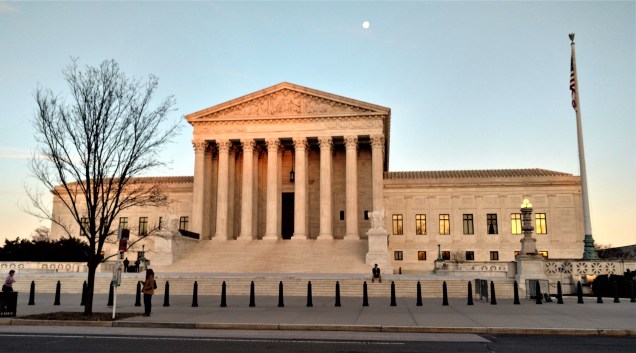
Transportation brokers, their insurers and lawyers sought a different result. Brokers were denied federal-law protection for negligence in Montgomery v. Caribe Transport II, LLC.
Typically, it took the Supreme Court just one paragraph to state its ruling:
The Federal Aviation Administration Authorization Act preempts state laws related to the prices, routes, and services of the trucking industry. But there is an important exception: States retain authority to regulate safety “with respect to motor vehicles.” This case presents the question whether a claim that one company negligently hired another to transport goods falls within that exception. It does.
The decision was unanimous, reversing the Seventh Circuit, which had held the broker, C.H. Robinson was shielded from liability by “FAAAA Preemption.” Justice Barrett wrote for the Court. Justice Kavanaugh, joined by Justice Alito, wrote a concurring opinion.
The Court explained that sellers of goods use brokers to find motor carriers to move their goods to market. The Motor Carrier Act of 1980 deregulated aspects of the industry and eased entry into the trucking business, reduced collective rate making, and encouraged greater flexibility in pricing. Yet, state regulations remained impediments to competition. Because over-regulation, especially by states, created inefficiencies in the trucking industry, Congress enacted the FAAAA, which expressly preempts certain state regulations involving motor carriers. A year later Congress amended the Act to extend to other players in the transportation industry, including brokers.
As now written, the FAAAA contains two provisions that bring this case to the Court. First, the Act prohibits States from “enact[ing] or enforc[ing] a law, regulation, or other provision having the force and effect of law related to a price, route, or service” of any motor carrier or broker “with respect to the transportation of property.” Transportation lawyers call this the “FAAAA Preemption.” But that does not end the story. The Amended Act also includes exceptions, one of which, the so-called “Safety Exception,” is at the heart of this case.
That exception provides that the Act “shall not restrict the safety regulatory authority of a State with respect to motor vehicles [Emphasis added].” The reading and interpretation of this provision and the underscored phrase, “with respect to motor vehicles,” are central to the Court’s determination.
Shawn Montgomery suffered serious injuries in a two-truck accident. Montgomery’s truck was struck by a tractor-trailer driven by Yosniel Varela-Mojena when it swerved off course. Varela-Mojena was driving for Caribe Transport II, LLC, a motor carrier. C.H. Robinson Worldwide, Inc., a broker, had coordinated the shipment. Montgomery sued Varela-Mojena, Caribe Transport, C.H. Robinson, and other related entities. Montgomery claimed that Caribe Transport had been found by the Federal Motor Carrier Safety Administration to be deficient with respect to the qualifications of drivers, hours of service of drivers, inspection, repair and maintenance, and recordable crash rate, and more. He alleged that C.H. Robinson negligently hired Caribe when it knew or should have known of its poor safety record.
C.H. Robinson raised the FAAAA Preemption defense and argued that the Safety Exception does not apply to brokers, since it mentions only motor carriers. The district court held that the FAAAA expressly preempts Montgomery’s negligent-hiring claim and that the claim does not fall within the Safety Exception. The Seventh Circuit affirmed based on its prior precedent. The Supreme Court granted Montgomery’s petition for Certiorari to resolve a division among the circuits.
C.H. Robinson argued that the Safety Exception barred only state laws (including case law) of a State “with regard to” motor vehicles, but does not mention brokers. Here we learn that words mean something. Noting that the statute does not define “with regard to,” the Court turned to its ordinary meaning. Dictionaries define the phrase as “referring to,” “concerning,” or “regarding.” Using these definitions and “putting the pieces together,” the Court concludes that a claim is “with respect to motor vehicles” if it “concerns” or “regards” the vehicles used in transportation.”
Applying that interpretation, the Court lays out its conclusion succinctly:
Requiring C.H. Robinson to exercise ordinary care in selecting a carrier therefore “concerns” motor vehicles – most obviously, the trucks that will transport the goods. So Montgomery’s negligent-hiring claim falls within the FAAAA’s safety exception, which saves it from preemption.
The issue has been debated for several years, with brokers hoping to receive FAAAA Preemption. The Supreme Court has dashed those hopes, and brokers, insurers, their lawyers, and the market will be reacting to this decision.

